Maya stared at her laptop screen, the cursor blinking mockingly in the empty text field labeled “Video Prompt.” She’d been commissioned to create a promotional video for a local art gallery, but after three hours of brainstorming, she had nothing. The deadline was tomorrow, and inspiration felt as distant as the moon outside her studio window.
“Maybe I’m overthinking this,” she muttered, remembering her AI Filmmaker mentor’s advice: “When you’re stuck, start experimenting. Feed the AI random ideas and see what sparks.”
Instead of crafting the perfect prompt, Maya decided to play. She typed her first random thought: “Paint dripping upward in reverse gravity.” The AI generated a mesmerizing 10-second clip of colorful paint flowing skyward like liquid fireworks. Not quite right for the gallery, but… interesting.
Next, she tried: “Marble statue coming to life in golden hour light.” The result was hauntingly beautiful – stone slowly transforming into flesh, shadows dancing across classical features. Still not it, but she felt a spark of excitement.
“What if I combine concepts?” Maya wondered. She experimented with hybrid prompts: “Ancient sculpture meets modern street art.” The AI produced something unexpected – graffiti flowing across marble like living tattoos, classical and contemporary art forms dancing together.
Her pulse quickened. This was the direction.
Over the next hour, Maya entered a flow state of experimentation. She tried:
- “Neon lights painting themselves onto museum walls”
- “Visitors’ reflections becoming part of the artwork”
- “Art pieces having conversations after closing time”
- “Paintbrush strokes floating through gallery space”
Each experiment revealed new possibilities. Some failed spectacularly – like the attempt at “Mona Lisa breakdancing” – but even the failures taught her something about the AI’s capabilities and her own creative boundaries.
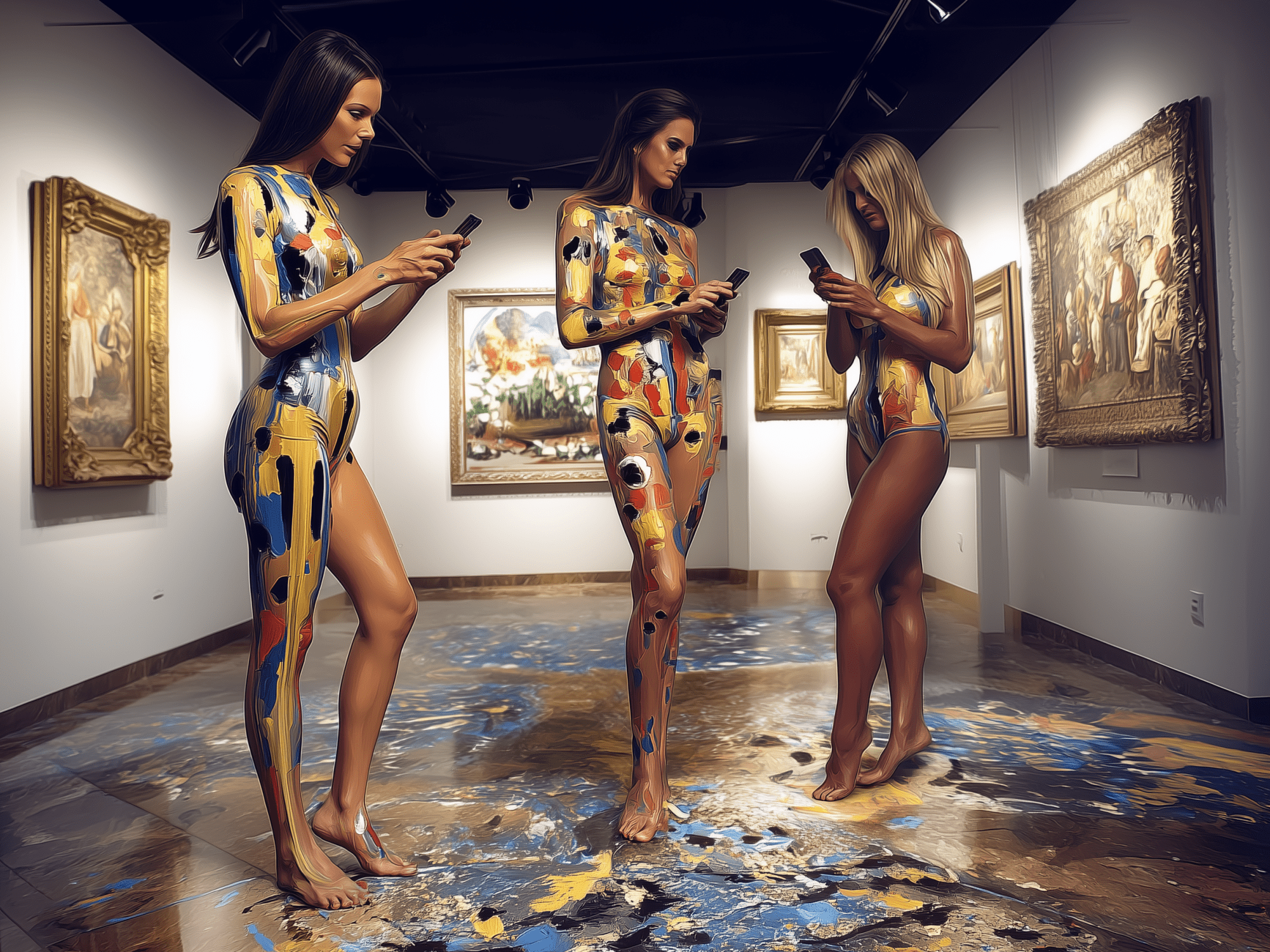
Around 2 AM, Maya struck gold with: “Gallery visitors become living paintings, their movements creating art trails behind them.” The AI generated footage of people walking through white spaces, leaving streams of color in their wake – blue from a woman in a flowing dress, gold from a child’s laughter, crimson from an elderly man’s careful steps.
But the real breakthrough came when she accidentally typed “artgallery” as one word instead of two. The AI interpreted this as something entirely different, creating abstract geometric spaces that pulsed with inner light. It was gorgeous, otherworldly, and perfect for the gallery’s contemporary exhibition theme.
Maya realized she’d discovered something profound: inspiration wasn’t hiding in her head waiting to be found – it was emerging from the collaborative dance between her curiosity and the AI’s interpretations. Each experiment built on the last, creating an exponential expansion of creative possibilities.
By dawn, she had her concept: a video showing how art and audience create each other, with visitors becoming part of the living gallery experience. But more importantly, she’d learned a new creative process.
The gallery owner called it “transcendent.” Maya called it “happy accidents and midnight experiments.”
From that night forward, Maya always began new projects the same way – not with the pressure of the perfect idea, but with the joy of feeding random thoughts to the AI and seeing what unexpected doors opened. She’d learned that in AI filmmaking, the path to inspiration wasn’t linear planning – it was playful experimentation.
Discover more from AI Film Studio
Subscribe to get the latest posts sent to your email.
