While Runway ML has emerged as a leading platform in AI-powered filmmaking, the generative AI landscape continues to evolve rapidly with several compelling alternatives worth exploring. For filmmakers seeking to expand their creative toolkit or find solutions better suited to specific project needs, understanding these alternatives is essential. Let’s examine the most viable Runway competitors, their unique strengths, and how they can complement your existing Midjourney and Runway workflows.
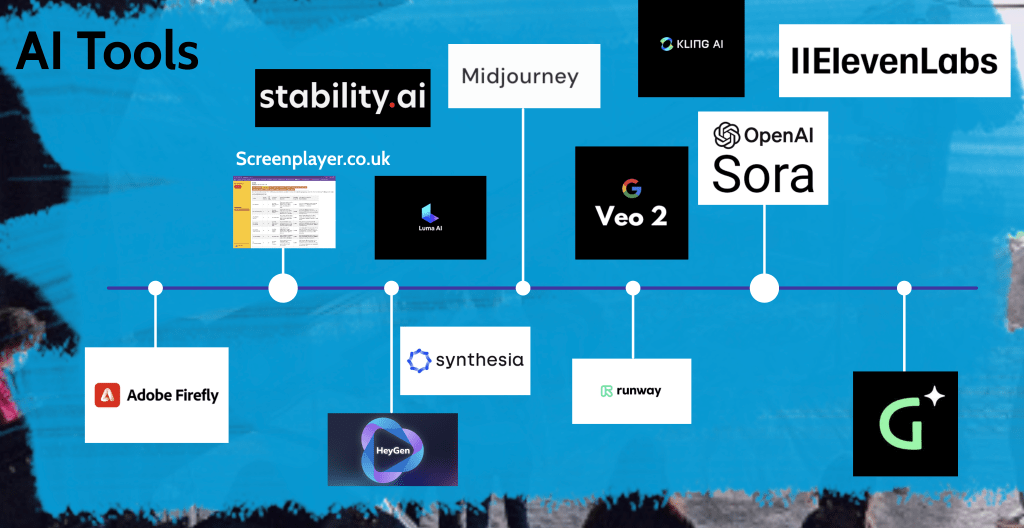
The Evolving Landscape of AI Video Generation
Runway’s popularity stems from its comprehensive suite of tools spanning image-to-video conversion, motion tracking, and sophisticated editing capabilities. However, several platforms offer unique advantages in specialized areas that might better serve particular production needs.
Top Runway AI Alternatives
Pika Labs
Pika has quickly established itself as a formidable alternative with strengths in character consistency and motion quality. Its text-to-video capabilities often produce more natural human movements than some competitors.
Practical Example: Fashion filmmaker Mei Zhang used Pika to generate runway sequences for a conceptual fashion film after finding that Pika maintained fabric texture details more consistently throughout the generation process. She notes, “The way Pika handled the subtle movements of textured fabrics gave my fashion film a level of realism I couldn’t achieve with other tools.”
D-ID
D-ID specializes in creating talking head videos from still images with remarkably realistic speech patterns and facial movements. This makes it particularly valuable for dialogue-heavy content or educational materials.
Success Story: Documentary producer James Chen utilized D-ID to bring historical photographs to life for “Voices of the Past,” creating interview-like segments with historical figures. “The ability to animate archival photographs with natural-looking speech patterns added an emotional dimension to the documentary that resonated deeply with audiences,” Chen explains.
Stability AI’s Stable Video Diffusion
Building on the success of Stable Diffusion for images, Stable Video Diffusion offers powerful text-to-video generation with exceptional creative control over stylistic elements.
Practical Application: Independent director Sophia Rodriguez combined Midjourney concept art with Stable Video Diffusion to create dreamlike sequence transitions for her experimental short film “Liminal Spaces.” She found that “Stable Video Diffusion maintained the distinctive artistic style from my Midjourney concepts more faithfully than other generators.”
EbSynth
Though more specialized than full-featured platforms like Runway, EbSynth excels at applying the style of one frame across an entire video sequence, making it invaluable for stylized animation and rotoscoping effects.
Success Story: Animator Alex Kim created a music video for indie band The Resonants by shooting basic performance footage, creating stylized keyframes in Midjourney, then using EbSynth to propagate those styles across the entire video. “The combination of Midjourney’s image generation and EbSynth’s temporal consistency created a visual style that would have been impossible to achieve through traditional animation techniques,” Kim notes.
Topaz Video AI
Focused on video enhancement rather than generation, Topaz Video AI offers best-in-class upscaling, frame rate conversion, and noise reduction—making it an excellent complement to generated content that might need technical refinement.
Practical Workflow: Documentary filmmaker Elena Martinez used Runway for initial generation of historical scene recreations, then employed Topaz Video AI to upscale the output to 4K resolution with enhanced frame interpolation. “The combination gave us historically accurate scenes with the technical quality expected by streaming platforms,” Martinez explains.
Integrating Alternatives with Midjourney and Runway
The most successful AI filmmakers rarely rely on a single platform. Instead, they develop workflows that leverage the strengths of multiple tools:
- Concept Development with Midjourney: Create detailed visual concepts and storyboards
- Primary Generation in Best-Suited Platform: Select the most appropriate video generation tool based on the specific requirements of the scene
- Refinement in Specialized Tools: Enhance, upscale, or modify generated content
- Final Integration in Runway: Use Runway’s strong editing and compositing capabilities to assemble the various elements
Workflow Example: Multi-Platform Music Video Production
Director Cameron Taylor’s award-winning music video “Synthetic Dreams” exemplifies this approach:
- Created detailed visual concepts in Midjourney
- Generated performance sequences in Runway
- Produced abstract transitions in Stable Video Diffusion
- Applied stylistic consistency using EbSynth
- Enhanced resolution and frame rate with Topaz Video AI
- Assembled and refined all elements in Runway’s editor
“Each platform brought something unique to the production,” Taylor explains. “Understanding the strengths and limitations of each tool allowed us to achieve results that wouldn’t have been possible using any single platform.”
When to Choose Alternatives Over Runway
Consider alternative platforms when:
- Character Animation is Priority: Pika often handles human movement more naturally
- Talking Head Videos are Needed: D-ID excels at realistic facial animation
- Artistic Style Consistency is Crucial: Stable Video Diffusion or EbSynth may better maintain distinctive styles
- Technical Quality Needs Enhancement: Topaz Video AI offers superior upscaling and frame interpolation
- Budget Constraints Exist: Some alternatives offer more affordable options for specific capabilities
Learning the Extended AI Filmmaking Ecosystem
For filmmakers looking to master this multi-platform approach, AI Filmmaker Studio (https://www.ai-filmmaker.studio) offers specialized courses covering the entire ecosystem of AI filmmaking tools. Their research-based curriculum goes beyond single-platform tutorials to explore optimal workflows combining Midjourney, Runway, and their alternatives.
Their “Integrated AI Production Pipeline” workshop specifically addresses how to determine which platform is best suited for different phases of production, helping filmmakers develop flexible workflows that maximize creative possibilities while minimizing technical limitations.
The Future of AI Filmmaking Platforms
As the technology continues to evolve, we can expect increased specialization among platforms alongside efforts to create more comprehensive solutions. The most successful filmmakers will be those who remain adaptable, continuously exploring new tools while developing systematic approaches to integrating them into cohesive workflows.
The competition among platforms is driving rapid innovation, with each new release pushing the boundaries of what’s possible in AI-generated content. For filmmakers, this means unprecedented creative opportunities—and the need to stay informed about the expanding toolkit available to them.
Conclusion
While Runway remains a powerhouse in the AI filmmaking space, exploring alternatives offers filmmakers expanded creative possibilities and solutions to platform-specific limitations. The most sophisticated productions increasingly rely on multi-platform approaches that leverage each tool’s unique strengths.
By understanding the full ecosystem of available tools and developing workflows that integrate them effectively, filmmakers can transcend the limitations of any single platform and achieve results that truly push the boundaries of what’s possible in AI-assisted filmmaking.
Discover more from AI Film Studio
Subscribe to get the latest posts sent to your email.
