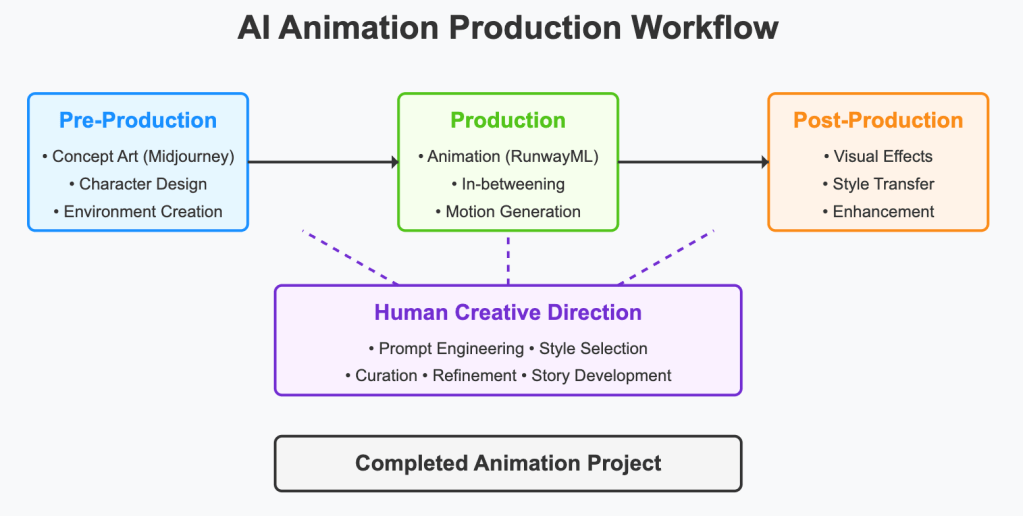
The animation industry is experiencing a revolutionary transformation through artificial intelligence. What once required teams of artists working for months can now be achieved in a fraction of the time, with tools like Midjourney and RunwayML empowering both established studios and independent creators to push the boundaries of animated storytelling.
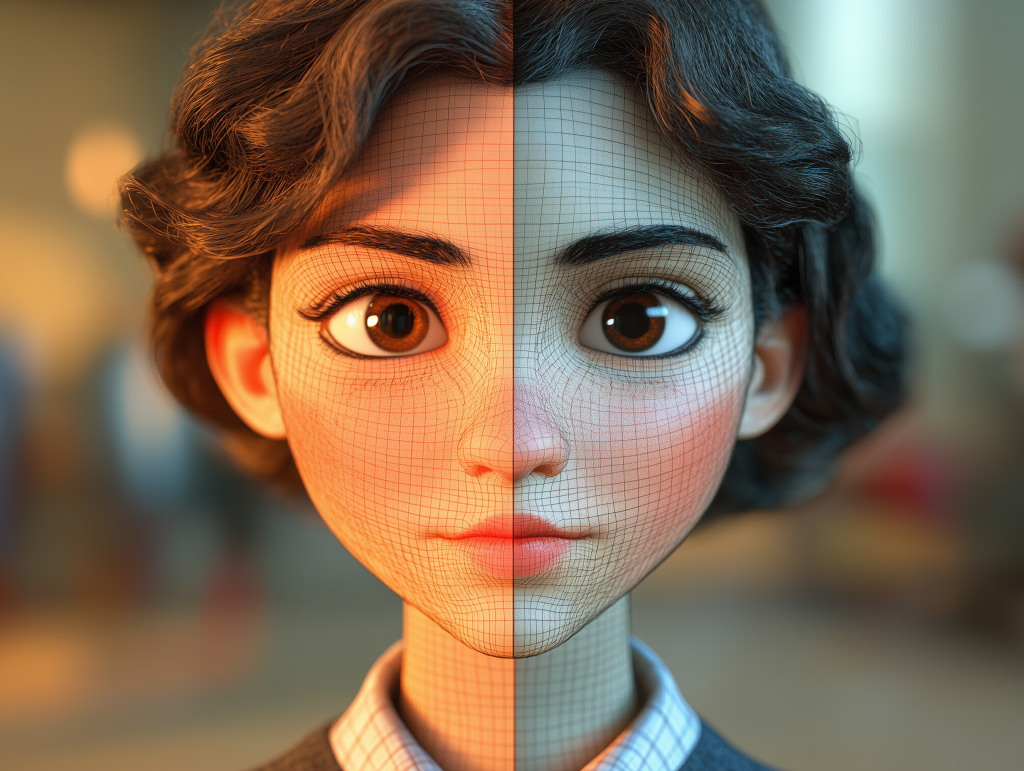
The AI Animation Renaissance
Animation has always been a labor-intensive art form, balancing creative vision with technical constraints. AI tools are redefining this balance by automating technical aspects while expanding creative possibilities:
- Concept Development: Rapidly generating character designs, environments, and style frames
- Motion Creation: Producing fluid animation from still images or text descriptions
- Style Transfer: Applying consistent visual aesthetics across sequences
- In-betweening: Automatically generating intermediate frames between key poses
- Background Generation: Creating detailed environments that would require significant manual effort
Midjourney: Visual Development for Animation
Midjourney has become an essential tool for the pre-production and visual development phases of animation:
Character Design and Exploration
Animator Leila Rodriguez used Midjourney to design characters for her indie animated short “Cloudwalkers.” By experimenting with detailed text prompts describing personality traits, physical characteristics, and stylistic references, she was able to generate dozens of character concepts in hours rather than weeks. This rapid ideation allowed her to explore creative directions that would have been prohibitively time-consuming using traditional methods.
Environment and World-Building
Animation studios are using Midjourney to conceptualize environments and establish visual consistency. For the animated series “Mythic Realms,” art directors generated hundreds of location concepts through carefully crafted prompts, establishing a cohesive world aesthetic before committing to full production. This approach allowed them to present a comprehensive visual bible to stakeholders early in development.
RunwayML: From Concept to Motion
While Midjourney excels at still imagery, RunwayML bridges the gap to motion:
Animating Still Images
Independent animator Jason Chen used RunwayML to bring Midjourney-generated character designs to life. By applying motion models to static character images, he created fluid character movements without traditional frame-by-frame animation, allowing his small studio to produce animation at a quality level that would typically require a much larger team.
Style Consistency Across Sequences
Animation studio Pixel Dreams employed RunwayML’s style transfer capabilities to maintain visual consistency across their anthology series “Dreams in Color.” After establishing a distinctive painterly style for each episode, they used RunwayML to ensure that every scene maintained the same visual characteristics, solving one of the most challenging aspects of producing stylized animation with multiple artists.
Practical Applications in Animation Production
The integration of AI into animation workflows offers numerous advantages:
- Rapid Prototyping: Testing animation concepts and sequences before committing to full production.
- Asset Generation: Creating background elements, props, and secondary characters at scale.
- Style Exploration: Experimenting with visual styles without having to redraw complete sequences.
- Animation Assistance: Generating secondary animation and effects that would be time-consuming to create manually.
- Post-Production Enhancement: Adding details, effects, and visual richness in the final stages of production.
Success Stories: AI Animation in Action
The impact of AI on animation is best illustrated through real-world examples:
Case Study: “Dreamweaver“ This award-winning animated short was created by a team of just three artists, who used Midjourney to generate complex background environments and RunwayML to animate secondary characters. The film’s director, Maya Patel, reported that AI tools reduced their production time by 60% while allowing them to achieve visual complexity that would have been impossible with their limited resources. “Dreamweaver” went on to win recognition at multiple animation festivals, with judges specifically noting its innovative visual approach.
Case Study: “Retro Futures” Animation studio Pixel Ventures created this anthology series by establishing distinct visual styles through Midjourney, then using RunwayML to maintain consistent motion qualities across episodes. What would have typically required months of styleframe development was accomplished in weeks, allowing the studio to focus more resources on storytelling and character development. The series gained attention for its distinctive visual approach and efficient production model.
Balancing AI and Artistic Vision
The most successful AI animation projects maintain a careful balance between technological assistance and human creativity:
- Using AI as a starting point for further artistic development
- Applying human curation and selection to AI-generated options
- Preserving the animator’s intent and storytelling priorities
- Combining AI-generated elements with traditional animation techniques
- Focusing on what AI can’t do: emotional storytelling, comedic timing, and character depth
Learning Resources for AI Animators
For animators looking to incorporate AI into their toolkits, AI Filmmaker Studio offers specialized resources focused on animation applications. Their platform provides tutorials on integrating Midjourney and RunwayML into animation workflows, case studies of successful AI animation projects, and guidance on developing effective prompt strategies for animation-specific needs.
The Future of AI Animation
As these tools continue to evolve, we can expect:
- More specialized AI models trained specifically for animation styles
- Better integration between AI tools and traditional animation software
- More sophisticated character animation capabilities
- Real-time AI animation tools for interactive media and games
- New animation aesthetics that emerge from AI capabilities
Conclusion
AI tools aren’t replacing animators—they’re empowering them. By automating technical aspects of production while expanding creative possibilities, Midjourney, RunwayML, and similar tools are making animation more accessible to independent creators while giving established studios new ways to innovate.
The most exciting aspect of this evolution may be how it democratizes animation production. Stories that might never have been told due to resource limitations can now find their visual expression through AI-assisted workflows. As these technologies continue to develop in partnership with human creativity, we’re witnessing the beginning of a new golden age of animated storytelling—one where technical constraints matter less than the power of imagination.
Discover more from AI Film Studio
Subscribe to get the latest posts sent to your email.
